What Happened
From May 20 to August 26, 2026, Pope Leo XIV devoted a series of Wednesday general audiences to catechesis on Sacrosanctum Concilium, the Second Vatican Council's constitution on the sacred liturgy, promulgated in 1963. The Vatican's own summary of the concluding August 26 session frames the series' purpose plainly: to help the faithful "contemplate and deepen" the "living bond" that unites the Church in "the mystery of Christ," and to walk through the Council's own stated aim in this document — "a general restoration of the liturgy itself," distinguishing what in worship is "divinely instituted" from what is merely a matter of custom. Coverage of the series' final weeks was headlined, tellingly, "Misinterpretations of Vatican II Liturgy Can Lead to Abuses" — and across the months Leo repeatedly returned to the theme of liturgical boundaries, teaching that "liturgical services are not private functions" but belong to the whole Church, and that every person taking part, minister or layman, is to perform, in the Council's own words, "all of, but only, those parts which pertain to his office by the nature of the rite" — a corrective aimed at both priests improvising outside the rubrics and laypeople treating Mass as a passive spectacle.
June: How Gesture Is Supposed to Shape the Soul
The main focus of this article is the session that fell on June 3, 2026, in the run-up to the Solemnity of Corpus Christi. There, Leo called on Catholics to "rediscover the signs and symbols of the sacred liturgy" — specifically naming the sign of peace, being sprinkled with holy water, and kneeling before the Blessed Sacrament. These, he said, "are not arbitrary gestures" but "the ecclesial mediation through which the divine gift reaches us," each one meant to help a worshipper physically enact and thereby experience "the presence of God through Jesus Christ." Days later, on June 7 (the Sunday celebration of Corpus Christi in most U.S. dioceses; June 22 the previous year in Rome's own calendar), Leo put that teaching into visible practice: presiding at Mass at Rome's Basilica of St. John Lateran, then leading the traditional Eucharistic procession on foot to the Basilica of St. Mary Major, carrying a golden monstrance containing the consecrated host under an ornamented canopy. At the basilica steps, by multiple published accounts, he knelt before the Host, incensed it, and then turned to bless the crowd with it — the very gesture his own catechesis, days earlier, had just called "a sign of our worship of God."
What the Mass Actually Claims to Be
To weigh any of this rightly, the claim itself has to be stated plainly. The Mass is not presented by Rome as a memorial only. Catholic doctrine teaches that at the priest's words of consecration, the bread and wine are transformed in substance — while still appearing as bread and wine — into the literal body and blood of Christ, and that this same Christ is thereby offered again, sacramentally, as a true and propitiatory sacrifice for the sins of the living and the dead. That is why the Host can be carried through the streets in a monstrance, reserved in a tabernacle, and knelt before between Masses: because the Roman system teaches that the bodily presence of Christ remains in the elements themselves, ongoing and repeatable, available to worship at will.
Comparing the Mass to the Lord’s Supper of Scripture
Scripture describes something considerably simpler, and considerably more final. Christ instituted a supper of remembrance the night before His death — "this do in remembrance of me" (Luke 22:19) — and Paul explains its purpose directly: "as often as ye eat this bread, and drink this cup, ye do shew the Lord's death till he come" (1 Corinthians 11:26). A memorial that looks back to a finished work and forward to His return is not the same act as a sacrifice repeated in the present. And Scripture is emphatic that the work being remembered was, in fact, finished:
Christ's own testimony is that His death accomplished, completely, what it set out to accomplish, laid down willingly and once. The book of Hebrews takes that same fact and draws out its consequence for any system that would repeat the sacrifice:
Read together, the argument is airtight on its own terms: redemption is already obtained, already eternal, and where sins have already been remitted, no further offering for sin is either needed or, on Scripture's own words, possible. A Mass that re-presents Christ as a propitiatory sacrifice, offered again and again at altars around the world, does not merely add an extra devotional practice on top of a finished work. It quietly undermines the efficacy of Christ's death, the sufficiency of His atonement, and the finality of His redemptive work — treating as ongoing and repeatable what Scripture insists was accomplished once, by Him alone, and is not to be added to.
Is It Good Practice to Kneel Before the Host? Scripture Says No
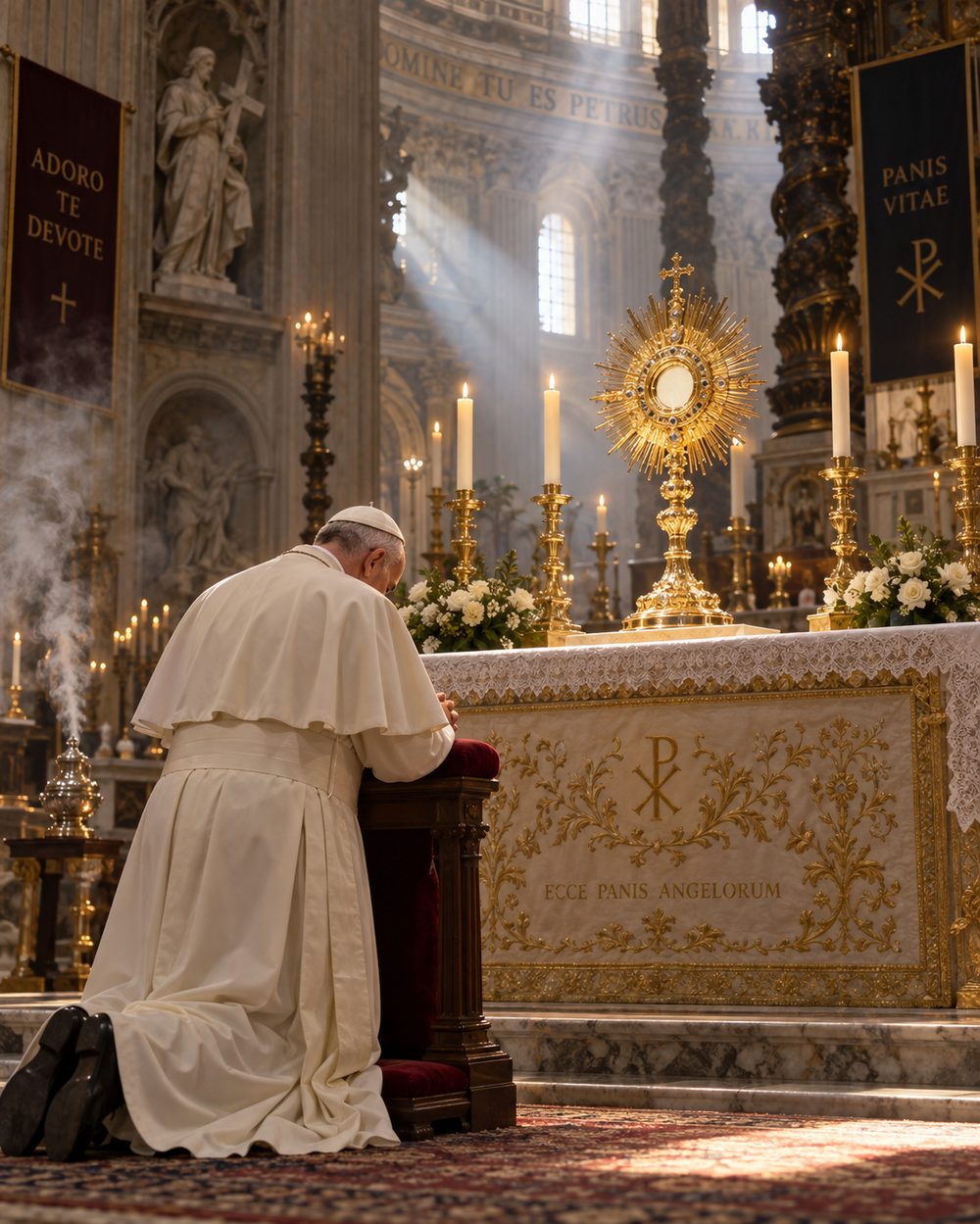
This is the direct question the June catechesis and the Corpus Christi procession both raise, and Scripture gives a direct answer. Worship — bowing, kneeling, reverencing an object or image as the locus of divine presence — belongs to God alone, and Scripture treats the substitution of anything else for that worship, however sincerely intended, as idolatry.
When Cornelius fell at Peter's feet to worship him, Peter's response was immediate: "Stand up; I myself also am a man" (Acts 10:25–26) — a mere man, however honored, refusing worship due to God alone. When John himself, overwhelmed, fell down to worship an angel, the angel's answer was the same: "See thou do it not… worship God" (Revelation 19:10; 22:8–9). If a glorified angel and an apostle both refused the worship due to God alone, a piece of consecrated bread — whatever claims are made about what it has become — has no better claim to it. Christ is not bodily present, hidden in wafers scattered across the world's altars and tabernacles; He is, by Scripture's own testimony, bodily risen, ascended, and seated at the right hand of God (Acts 1:9–11; Hebrews 10:12), to be worshipped there in spirit and in truth, not sought or knelt to in a monstrance carried through the streets of Rome. Kneeling before the Host does not merely misdirect sincere devotion. On Scripture's own terms, it is the very substitution of a "likeness" for the living God that the second commandment names and forbids.
A Call to Consider the Evidence
None of this requires doubting the sincerity of the pilgrims who lined a Roman street to watch a golden canopy pass by, or of a pope who plainly believes every word of what he taught this June. What it does require is naming plainly what a careful comparison of Rome's own claims against Scripture's own words shows: a Mass built on a sacrifice that Hebrews says cannot and need not be repeated, culminating in a procession that asks the faithful to kneel before bread as though before God Himself. Christ's own last word from the cross was not a beginning to be continued at ten thousand altars every day since. It was a completion: "It is finished." Nothing built afterward, however solemn the vestments or ancient the procession, can add to that word without first contradicting it.
Sources drawn from Vatican News, EWTN News, Catholic World Report, OSV News, Rome Reports, and ACI Africa coverage of Pope Leo XIV's May-August 2026 catechesis series on Sacrosanctum Concilium, including the Vatican's own published general audience texts (vatican.va) for June 3 and August 19 and 26, 2026; and CNS, Vatican News, Aleteia, and Catholic Leader reporting on the 2025 and 2026 Corpus Christi Masses and Eucharistic processions in Rome. Updated September 13, 2026.